
Video Boost APK (2026): Cloud AI Night Video Enhancer!
⚡ The Future-Prediction Hook:
Within three years, the concept of “grainy night video” will be obsolete. We are currently witnessing a massive shift in mobile videography where the processing power of a smartphone is no longer the bottleneck. By utilizing the Video Boost APK framework in 2026, content creators are offloading complex 4K temporal denoising algorithms to massive cloud server farms—transforming unusable dark footage into cinematic masterpieces with a single tap.
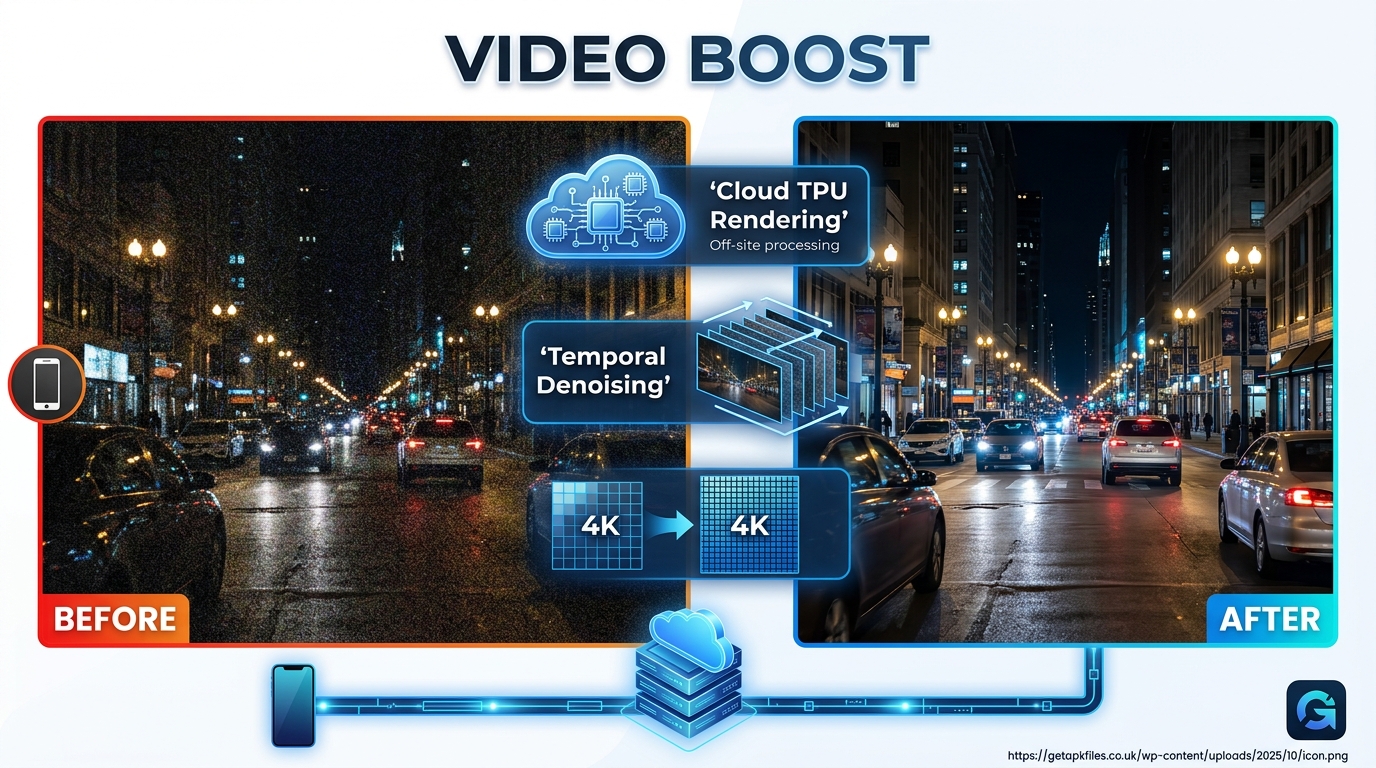
The Physics of Low-Light Video Limitation
To appreciate this technological leap, we must examine the physical limitations of smartphone cameras. Unlike photography, which can utilize long exposure times to gather light in the dark, a video camera must capture 30 to 60 frames every single second. As documented in Google’s computational photography archives, to expose a frame that quickly in low light, the camera software drastically increases the sensor’s ISO sensitivity. This artificially boosts brightness but introduces massive digital static, commonly known as “noise.”
In late 2023, Google disrupted the industry by introducing “Video Boost” on the Pixel 8 Pro. They realized that a mobile Snapdragon or Tensor processor simply could not perform heavy, frame-by-frame noise reduction without the battery draining instantly or the phone overheating. Their solution was architectural: the phone records a standard 1080p file locally but simultaneously uploads a raw metadata file to Google’s cloud Tensor Processing Units (TPUs). By 2026, third-party developers have democratized this cloud architecture, allowing any Android user to download APKs that interface with independent server farms for professional-grade upscaling.
The Asynchronous Cloud Architecture
One of the most crucial concepts for users downloading AI enhancement tools to grasp is the waiting period. Genuine AI video processing is not an instant Instagram filter. It utilizes an asynchronous workflow. When you tap “Enhance” within a legitimate Video Boost app, your phone initiates a three-step data pipeline.
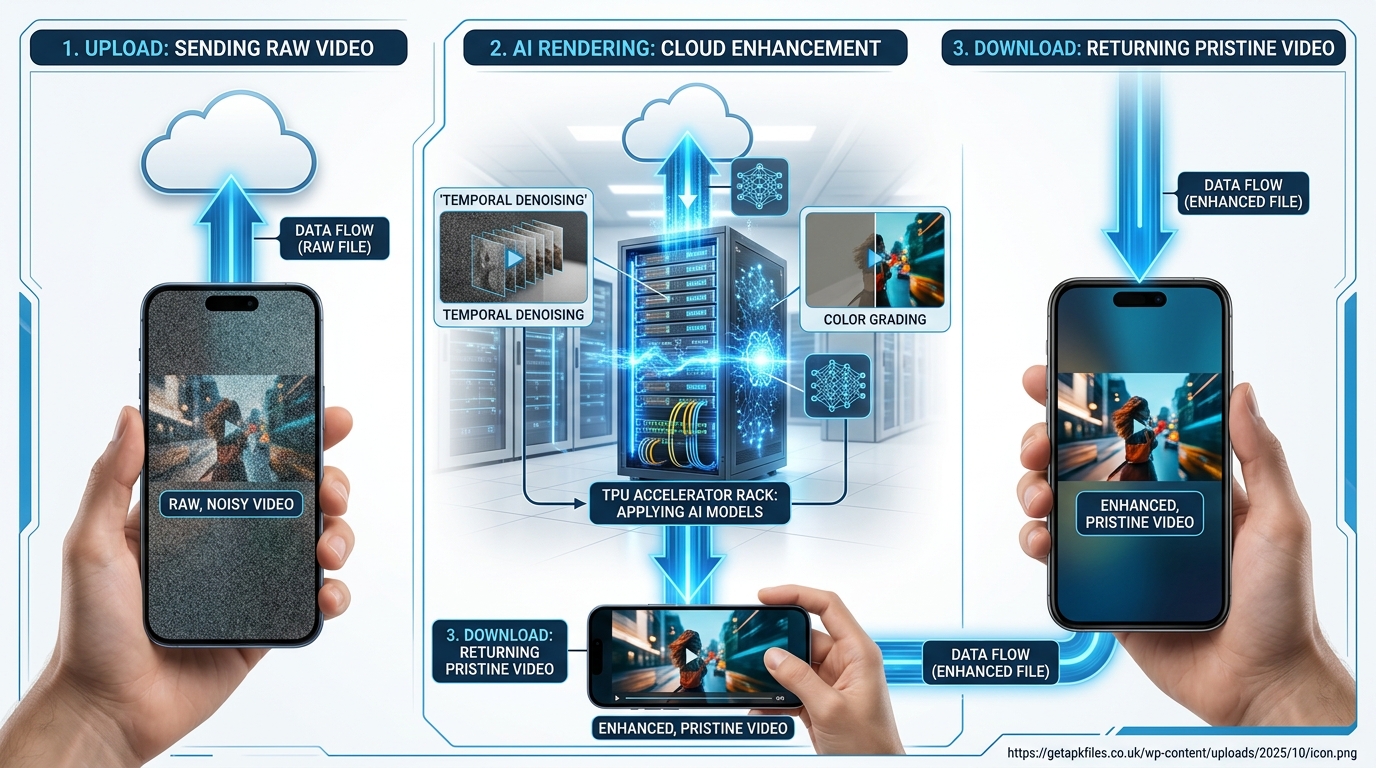
First, the original heavily compressed file is transmitted via Wi-Fi to a remote server. Second, the cloud AI unpacks the file and begins rendering the footage at roughly 1 frame per second (meaning a 10-second clip might take minutes to process). Finally, the server compiles the new 4K HDR master file and sends a push notification to your device prompting the download.
Temporal Denoising vs. Spatial Blurring
Why does cloud enhancement look so much better than the built-in filters on your phone? Cheap, offline editing apps use “Spatial Denoising.” This algorithm looks at a single frame, identifies pixel grain, and simply blurs it. The result is a video that looks like it was painted with watercolors—smeary and devoid of texture.
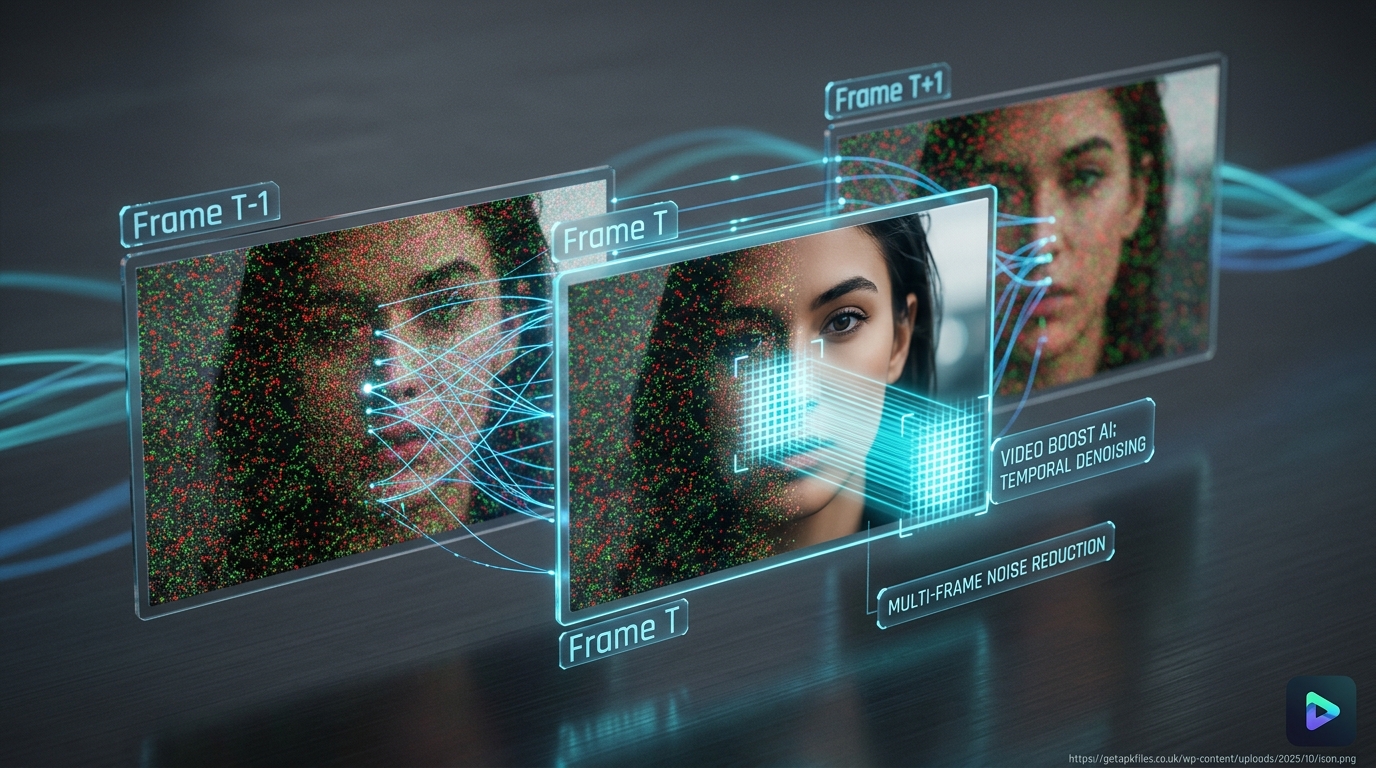
Advanced platforms utilize “Temporal Denoising.” As detailed by Topaz Labs’ enhancement architecture, the AI analyzes multiple frames simultaneously (past, present, and future). By tracking objects moving through time, the neural network can distinguish between random digital static (which changes every frame) and a physical object like a brick wall (which remains constant). Once the noise is stripped away, Generative AI hallucinate missing sub-pixels, allowing the app to successfully upscale a blurry 1080p clip into a crisp, cinematic 4K file.
Security Audit: Navigating the Fake APK Minefield
Because “Video Boost” is a highly lucrative search term, malicious developers have flooded third-party repositories with fake applications. You must be extremely cautious when sideloading files from unknown sources.

A legitimate Cloud AI tool (like HiQuality or Wink) will clearly state its subscription costs for server time and will require an internet connection to render. If an app promises instant 4K upscaling offline for free, it is mathematically impossible and likely a scam.
Comparative Assessment: Mobile APK vs. Desktop Processing
For serious content creators, the ultimate question remains: Should you rely on a mobile cloud APK, or invest in dedicated desktop software for your low-light enhancement needs?
| Evaluation Criteria | Mobile Cloud APKs (e.g., Wink, HiQuality) | Desktop Software (e.g., Topaz Video AI) |
|---|---|---|
| Hardware Requirements | None. Runs on budget Androids via cloud. | Requires $1,500+ dedicated GPU (RTX 4070+). |
| Cost Structure | Subscription models ($5-$15/month). | High upfront cost ($299 one-time purchase). |
| Rendering Speed | Dependent on server queue and Wi-Fi speed. | Instant local rendering (hardware dependent). |
| Privacy / Security | Footage uploaded to remote servers. | 100% local processing; files never leave machine. |
Our technical assessment concludes that for travel vloggers or casual users looking to fix a dark concert video, the subscription-based Cloud APKs offer unparalleled convenience. However, professional videographers handling confidential client data or massive terabyte-sized files must utilize local desktop rendering to bypass cloud upload bottlenecks and maintain strict privacy compliance.
Expert Visual Cloud Architecture Guides
Understanding Cloud Processing: A detailed breakdown of how raw video files are packaged and sent to remote TPU server farms for temporal denoising and HDR grading.
Top Mobile Alternatives: A 2026 showcase of the top Android applications currently utilizing AI upscaling to fix blurry or dark video footage.
Professional Desktop Video Enhancement
If cloud upload times are too slow for your production workflow, take control of your processing pipeline. Invest in the industry standard for AI frame interpolation and noise reduction.
Explore Topaz Video AI Disclosure: This post contains affiliate links. We may earn a commission at no extra cost to you.Deep Dive: Computational Video Resources
Review our curated technical resources to master the mechanics of AI temporal upscaling.
Final Expert Verdict: The End of Grainy Video
Our deep-dive analysis confirms that the era of relying on local smartphone silicon to fix low-light video is over. By utilizing third-party Video Boost APK platforms, Android users can now harness the power of remote server farms to apply professional temporal denoising to their footage. While users must navigate the app store carefully to avoid fake media players and be mindful of data upload bandwidth, the results are undeniable. Computational cloud videography is the definitive solution to rescuing your dark, unusable memories.
Download Video Boost APK: Cloud AI Night Video Enhancer! APK
Safe, verified, and scanned for viruses.
Leave a Reply