
Gemini Advanced (2026): Deep Research & AI Agents Explained
🔮 The Future-Prediction Hook:
By 2027, you will no longer search the web manually. You will deploy autonomous software agents to browse, click, and synthesize data for you. Google’s Gemini Advanced ($19.99/month) is the bridge to that exact future. Today, we decode the architecture behind it.
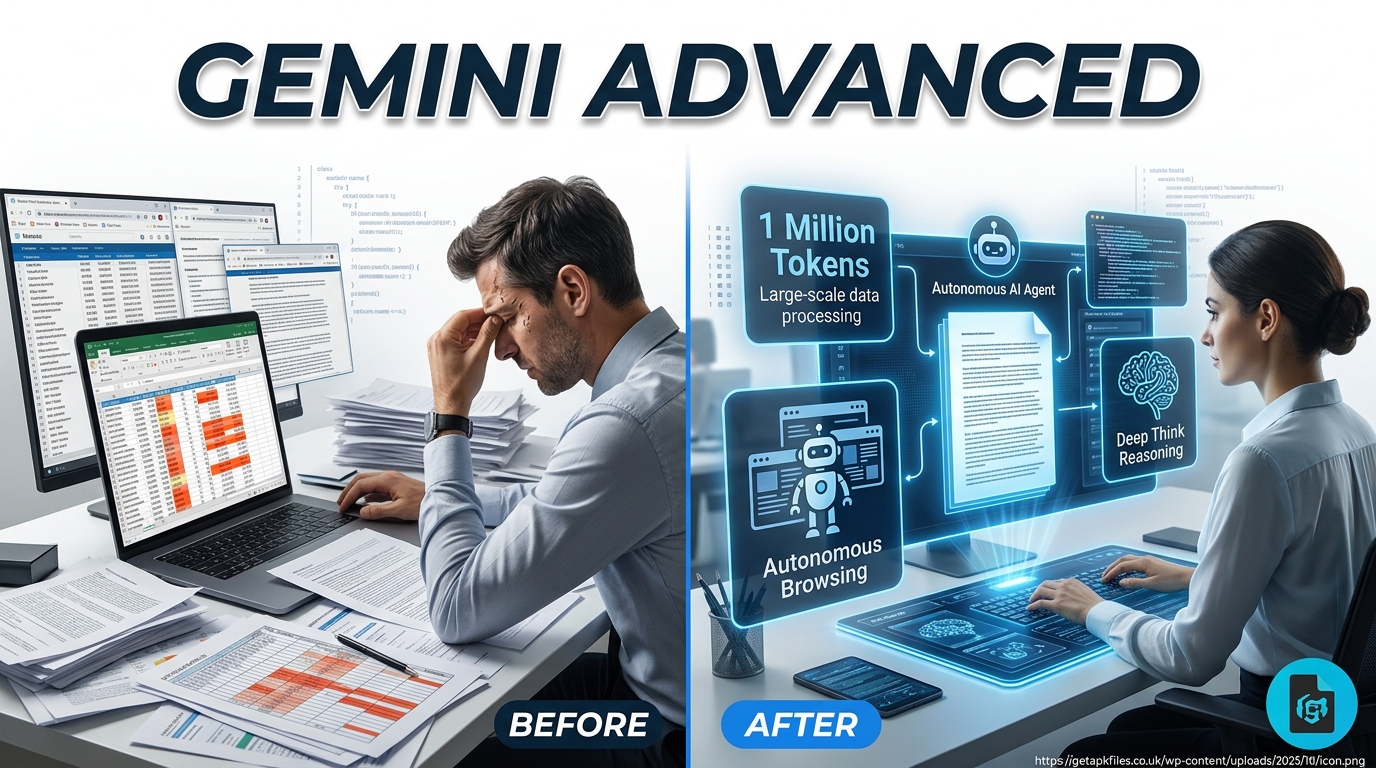
The era of the “chatbot” is officially dead. If you are still using AI simply to rewrite emails or summarize short texts, you are severely underutilizing the technology.
In 2026, the artificial intelligence landscape shifted from generative text to agentic action. Google restructured its premium AI tier—now widely known through the Google One AI Pro and Ultra plans—introducing a suite of tools designed for enterprise-grade logic. We are talking about Gemini 3.1 Pro, the autonomous Project Mariner browser agents, and the highly anticipated Deep Think System 2 reasoning models.
As a technical problem-solver, you likely want to know one thing: Does the math justify the $20 monthly subscription? Let’s break down the underlying architecture of these new tools, compare them directly against free chatbot alternatives, and examine how they integrate with your daily workflow.
The Architectural Evolution: From Bard to Agentic AI
To understand the power of Gemini Advanced today, we must look at the rapid historical evolution of Large Language Models (LLMs). Just a few years ago, AI models suffered from severe “amnesia.” Early versions of ChatGPT and Google Bard had context windows of roughly 8,000 tokens. They could not read a whole book, let alone analyze a financial database.
As documented in the historical archives of software agents, the breakthrough occurred when Google introduced the 1-million token context window with Gemini 1.5 Pro. According to Google DeepMind’s research division, this allowed the AI to ingest massive datasets simultaneously. By early 2026, this evolved into Agentic Vision and the Gemini 3.1 Pro architecture. The AI was no longer just a passive reader; it became an active investigator. Historical computing records at the Smithsonian show that bridging the gap between “information retrieval” and “automated execution” has been computer science’s holy grail for decades.
Deep Research: The End of Manual Googling
The crown jewel of the Gemini Advanced subscription is Deep Research. Standard AI models hallucinate facts because they guess the next word based on training data. Deep Research takes a completely different, multi-step programmatic approach.
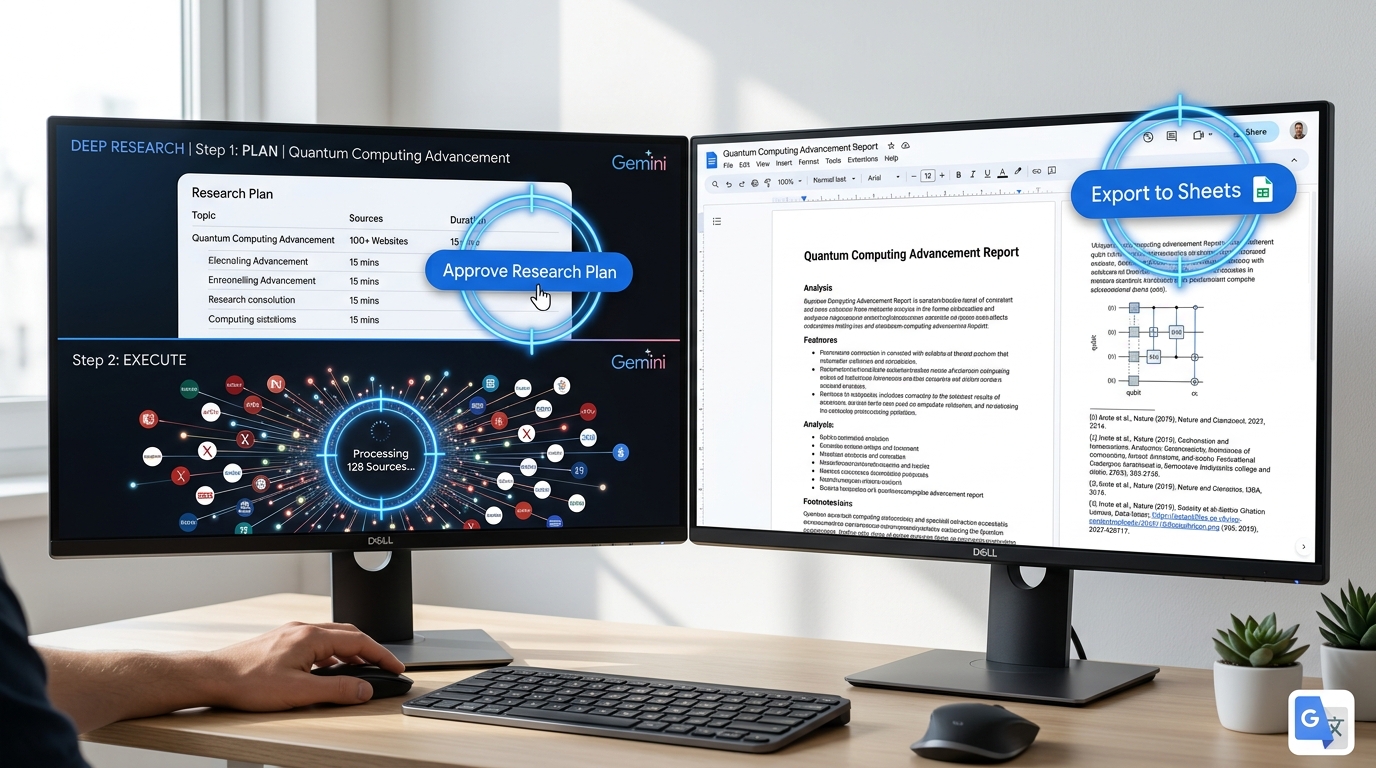
The Agentic Research Workflow
- Query Analysis: You prompt Gemini with a complex query (e.g., “Analyze the 10-year market trends of solid-state EV batteries”).
- Plan Generation: Gemini outputs a structured “Research Plan” outlining exactly which databases and metrics it intends to query. You must approve or edit this plan.
- Autonomous Execution: The agent spins up multiple parallel browser instances in the cloud, crawling over 100+ websites, reading PDFs, and extracting data.
- Synthesis & Citation: It formats the findings into a comprehensive Google Doc, complete with hyperlinked inline citations.
According to Google Workspace reports, this feature alone is saving financial analysts and academics over 15 hours a week. You effectively have a tireless intern working in the background.
Gemini 3.1 Pro: Ingesting Massive Data
At the core of the Advanced tier is the Gemini 3.1 Pro model. Its defining characteristic is its massive context window. While free users get access to the faster, lighter Gemini 3 Flash model, Pro users can upload enormous files.
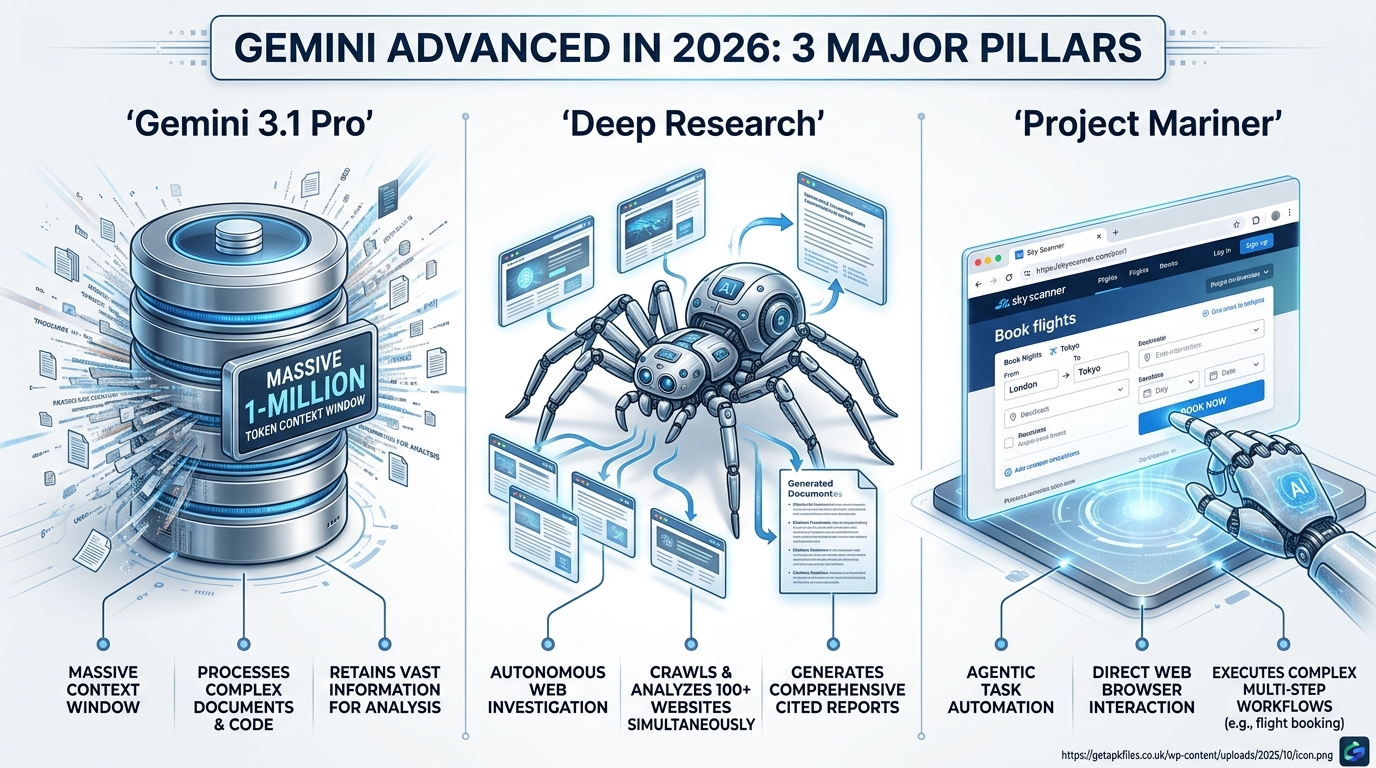
You can upload up to 1,500 pages of PDF text, 1 hour of video, or 30,000 lines of code in a single prompt. For developers trying to debug a complex application, or legal teams analyzing contracts, this token efficiency is non-negotiable. Furthermore, new Agentic Vision capabilities allow the AI to “zoom in” and inspect complex diagrams or charts within those PDFs, dramatically reducing visual hallucinations.
System 2 Reasoning: Enter “Deep Think”
Perhaps the most profound technical leap in 2026 is the introduction of Gemini Deep Think. Historically, LLMs used “System 1” thinking—fast, intuitive pattern matching. This is great for writing poetry, but terrible for advanced mathematics.

As reported by Chrome Unboxed, Deep Think introduces “System 2” deliberate reasoning. When you toggle Deep Think on, the AI pauses. It uses reinforcement learning to test multiple problem-solving paths in parallel. It checks its own math, discards failed hypotheses, and then presents the final, verified answer. This feature is heavily gated (often reserved for Google AI Ultra subscribers or high-tier enterprise users), but its integration into the broader Gemini API changes how we approach logic-heavy programming tasks.
Project Mariner: Your Browser Copilot
Reading data is only half the battle. Executing tasks is the other. Project Mariner is Google DeepMind’s answer to AI autonomy. Instead of just giving you instructions on how to book a flight or navigate a complex CRM, Mariner actually takes control of your browser to do it.
Using a specialized Chrome extension framework, Mariner visually reads the pixels on your screen. It identifies buttons, text fields, and drop-down menus. If you ask it to “Order my usual groceries from Walmart and use my saved Google Wallet for payment,” Mariner navigates the UI autonomously. According to TechCrunch, this level of agentic automation is actively rolling out to Gemini Advanced users, redefining desktop productivity.
Comparative Review: Gemini Advanced vs. ChatGPT Plus
In the battle of the $20/month subscriptions, how does Gemini Advanced compare to OpenAI’s ChatGPT Plus (specifically the o3 model)? The distinction lies in workflow integration.
| Feature/Metric | Gemini Advanced (Google AI Pro) | ChatGPT Plus (OpenAI) |
|---|---|---|
| Deep Research Strategy | Requires user to approve a structured research plan first. Highly accurate. | “Black box” autonomous search. Faster, but prone to going off-topic. |
| Context Window | 1,000,000 to 2,000,000 Tokens. Incredible for massive codebases. | 128,000 Tokens. Struggles with large, multi-document uploads. |
| Ecosystem Integration | Native integration into Gmail, Google Docs, Sheets, and Drive. | Standalone app. Requires copy-pasting to your word processor. |
| Action Agents | Project Mariner (Live UI interaction on Chrome). | Operator/Computer Use (Currently in limited enterprise preview). |
As highlighted in a recent TechRadar benchmarking test, if you live inside the Google Workspace ecosystem, Gemini Advanced is vastly superior. The ability to export a synthesized Deep Research report directly into a formatted Google Doc is a game-changer.
Expert Multimedia Analysis
Deep Research Workflows: A real-time developer demonstration of how Gemini Advanced analyzes complex financial metrics across hundreds of sites simultaneously without hitting rate limits.
Project Mariner Agents: An in-depth look at how Google’s autonomous web-browsing agent interacts with user interfaces, fills out forms, and navigates the web on your behalf.
Maximize Your AI Productivity Setup
Deep Research requires screen real estate. Don’t bottleneck your Gemini Advanced workflow on a single tiny screen. Upgrade to an Ultra-Wide curved monitor to view your source data alongside your generated Google Docs.
Check Current Monitor Prices Disclosure: This post contains affiliate links. We may earn a commission at no extra cost to you.Deep Dive: Interactive Agentic Learning
Want to truly master Gemini’s agentic tools? We converted Google DeepMind’s technical whitepapers into interactive learning modules using Google’s own NotebookLM. Explore them below.
Final Expert Verdict: Is It Worth $20?
If you use AI solely to draft polite emails or brainstorm blog post titles, the free Gemini 3 Flash tier is more than sufficient. You do not need to upgrade.
However, if your daily workflow involves analyzing massive datasets, reading extensive PDFs, or compiling deep comparative research, Gemini Advanced is an absolute necessity in 2026. The integration of Deep Research alone provides a massive ROI by replacing hours of tedious data compilation. When combined with the autonomous capabilities of Project Mariner and the massive 1M token context window of Gemini 3.1 Pro, this subscription transitions from a “cool tech toy” to an essential enterprise productivity engine.
Download Gemini Advanced: Deep Research & AI Agents Explained APK
Safe, verified, and scanned for viruses.
Leave a Reply